





OECD Flag
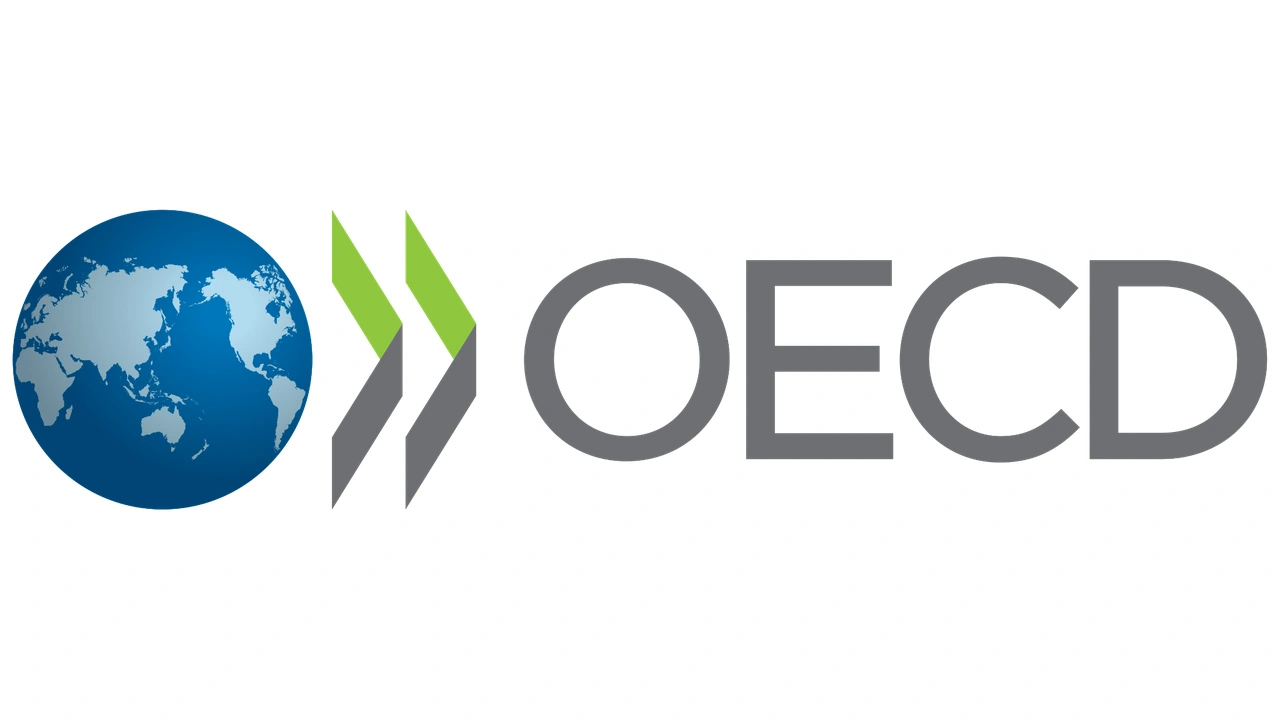
The OECD flag displays the organisation’s emblem, which combines a stylized globe with dynamic arrow-like shapes. The globe emphasizes the international reach of the Organisation for Economic Co-operation and Development, while the directional elements suggest exchange, progress and cooperation across borders. The emblem reflects the OECD’s mission of bringing countries together to share evidence, compare policies and address common economic and social challenges. It is an institutional symbol, not a national flag, and should be understood in the context of the organisation’s global policy work.
The Organisation for Economic Co-operation and Development (OECD) was established in 1961, building on the Organisation for European Economic Co-operation (OEEC), which had been founded in 1948 to help coordinate European recovery and Marshall Plan assistance after the Second World War. The OECD expanded this earlier European framework into a broader international organisation focused on economic cooperation and policy analysis. Over subsequent decades, countries from outside Europe joined, widening its geographic scope. The OECD became known for comparable international statistics, country economic surveys, policy recommendations and work on education, taxation, development and governance. Its activities continue to evolve as governments address global challenges including productivity, climate change, digital transformation and inequality.
• Established: 1961, succeeding the OEEC.
• Predecessor: The OEEC was created in 1948.
• Headquarters: Paris, France.
• Membership: 38 member countries as of 2026.
• Policy research: The OECD publishes economic surveys and internationally comparable statistics.
• Education: Its PISA assessment compares learning outcomes among participating education systems.
• Tax cooperation: It helps countries develop approaches to international taxation and transparency.
• Development: The OECD hosts the Development Assistance Committee (DAC).
• Global reach: OECD analysis and standards are used by many non-member economies as well.
Key Facts
• Full name: Organisation for Economic Co-operation and Development.
• Established: 1961.
• Headquarters: Paris, France.
• Members: 38 (2026).
• Core work: Economic analysis, policy standards, research and international cooperation.
The OECD is an intergovernmental organisation that provides a platform for countries to compare experiences, examine evidence and develop policy approaches. It produces data, forecasts, reports and international standards across economic and social policy. Its work spans employment, trade, investment, education, public governance, tax policy, environmental sustainability, digital transformation and development. Rather than acting as a world government, the OECD supports its members and partner countries through research, peer review, dialogue and agreed recommendations. Its overarching objective is to help governments design policies that improve economic resilience, opportunity and well-being.
Discover World Best Flags
Premium Quality Flag Media in Multiple Formats
Explore our collection of flags available in GIF, FHD, and stunning 4K video formats, perfect for educational, commercial, or personal projects.
GIF Format
Animated flag GIFs perfect for websites, presentations, and social media. Lightweight and compatible with all platforms.
FHD Video
High-definition flag videos with crisp details and smooth motion. Ideal for professional presentations and digital displays.