




Gulf Cooperation Council
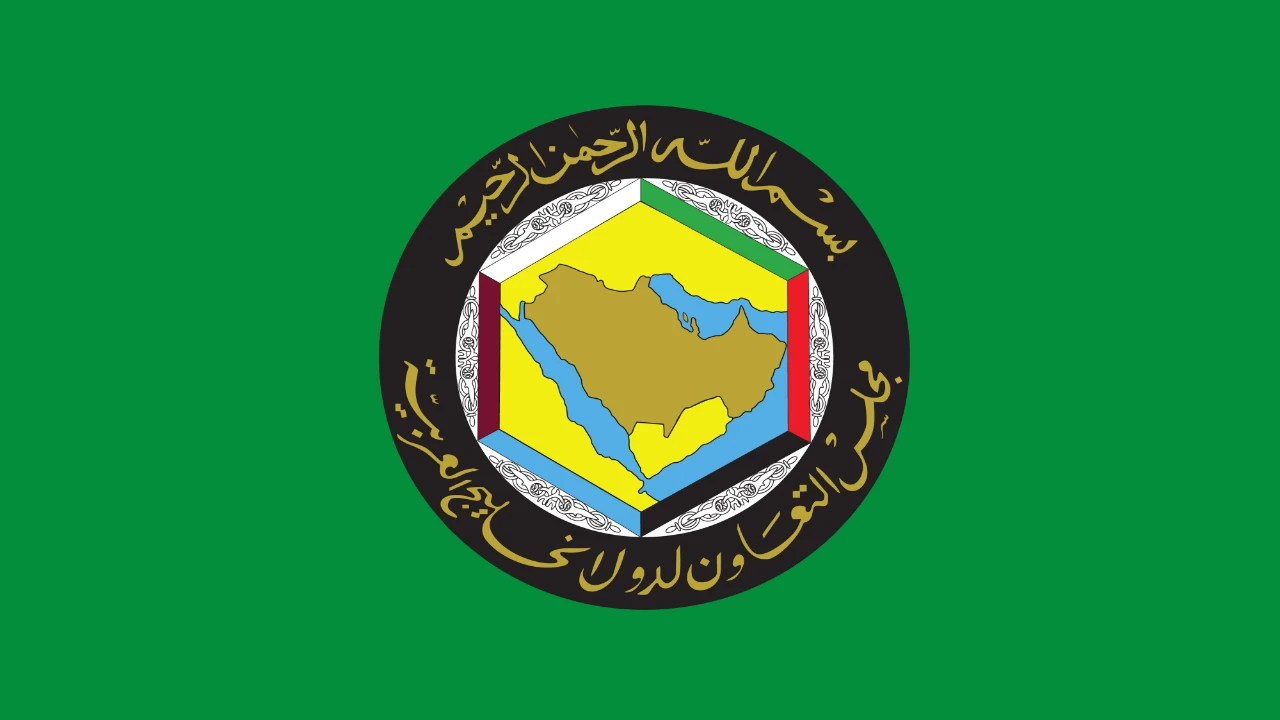
The flag associated with the Gulf Cooperation Council (GCC) represents the shared identity and cooperation of six Gulf Arab states: Bahrain, Kuwait, Oman, Qatar, Saudi Arabia and the United Arab Emirates. The emblem at its centre identifies the Council as a regional institution rather than the flag of any one member country. Its circular design brings together the idea of a common Gulf framework with the distinct sovereignty of its members.
The GCC emblem features a hexagonal form reflecting the six founding member states, surrounded by Arabic lettering identifying the Cooperation Council for the Arab States of the Gulf. The symbol is widely used on official communications and at GCC meetings. Its principal message is solidarity, coordination and a commitment to regional cooperation. Specific colour interpretations should not be treated as official unless supported by an authoritative GCC explanation.
The Gulf Cooperation Council was established on 25 May 1981 at a summit in Abu Dhabi, United Arab Emirates. Its six founding members were Bahrain, Kuwait, Oman, Qatar, Saudi Arabia and the United Arab Emirates. The Council emerged from a shared interest in closer political, economic, social and security coordination among neighbouring Gulf states.
The GCC Charter established a framework for cooperation through the Supreme Council, the Ministerial Council and the Secretariat General. The Secretariat General is based in Riyadh, Saudi Arabia. Over subsequent decades, member states developed joint initiatives in trade, customs, economic integration, infrastructure and other areas of public policy.
Major milestones include the launch of the GCC Customs Union in 2003 and the Gulf Common Market in 2008. These initiatives were intended to make trade and economic activity easier across member states, although practical implementation and integration continue to evolve. Today, the GCC remains an important forum for consultation and coordination on regional challenges and long-term development.
• The GCC was founded on 25 May 1981 in Abu Dhabi.
• Its six founding members remain Bahrain, Kuwait, Oman, Qatar, Saudi Arabia and the United Arab Emirates.
• The Secretariat General is located in Riyadh, Saudi Arabia.
• The organisation's official name is the Cooperation Council for the Arab States of the Gulf.
• The Supreme Council, comprising the member states' heads of state, is the GCC's highest authority.
• The GCC Customs Union began operating in 2003.
• The Gulf Common Market was launched in 2008.
• GCC cooperation covers areas such as economic policy, transport, education, health and security.
• Each member state retains its own government, laws and national flag.
Key Facts
• Established: 25 May 1981
• Headquarters: Riyadh, Saudi Arabia
• Member states: 6
• Founding summit: Abu Dhabi, United Arab Emirates
• Main bodies: Supreme Council, Ministerial Council and Secretariat General
• Primary purpose: Coordination, integration and cooperation among Gulf member states
The Gulf Cooperation Council (GCC) is a regional intergovernmental organisation bringing together Bahrain, Kuwait, Oman, Qatar, Saudi Arabia and the United Arab Emirates. Its purpose is to deepen coordination, integration and cooperation among member states while respecting their national sovereignty.
Economic cooperation is a major part of its work. GCC initiatives address trade, customs arrangements, investment, standards and the movement of goods and people, including the development of a common market. The Council also provides a platform for cooperation on infrastructure, transport, energy and digital development.
Beyond economics, GCC institutions support dialogue on regional security, public health, education, environmental challenges and other shared concerns. Decisions and policies are developed through the Council's intergovernmental bodies and implemented by the member states according to the relevant agreements and national arrangements. The GCC is therefore both a symbol of Gulf regional identity and a practical forum for coordinating policies across six neighbouring countries.
Discover World Best Flags
Premium Quality Flag Media in Multiple Formats
Explore our collection of flags available in GIF, FHD, and stunning 4K video formats, perfect for educational, commercial, or personal projects.
GIF Format
Animated flag GIFs perfect for websites, presentations, and social media. Lightweight and compatible with all platforms.
FHD Video
High-definition flag videos with crisp details and smooth motion. Ideal for professional presentations and digital displays.